Morning Coffee, Evening Quiet: Why Danish Nomads Carry Rituals Instead of Comfort Objects
The Comfort Myth We've All Been Sold
There's a particular kind of exhaustion that hits when you've spent forty minutes on Booking.com trying to find a place with the right aesthetic. The warm lighting. The linen throws. The artisan coffee shop around the corner. British travellers, especially those who've gone remote and long-term, know this spiral intimately. We've been conditioned to believe that the right environment will make us feel okay — that comfort lives inside four walls, not inside us.
Danish nomads, broadly speaking, don't think this way. And after spending time with a few of them — in Lisbon co-working spaces, Chiang Mai guesthouses, and the occasional windswept Airbnb on the Faroe Islands — it becomes obvious why they seem so effortlessly settled wherever they land. It's not that they've found better places. It's that they've stopped looking to places to do the emotional heavy lifting.
The concept at play here borrows from hygge — that much-misunderstood Danish notion that gets reduced to scented candles and knitted socks in British lifestyle magazines. The real thing is quieter and more radical than that. Hygge is fundamentally about atmosphere over aesthetics, presence over possessions. And when you're living out of a single bag across multiple countries, that distinction becomes everything.
What a Ritual Actually Does (That a New Throw Pillow Can't)
Let's get specific, because this is where the idea stops being abstract and starts being genuinely useful.
A ritual, in the nomadic sense, is a small, repeatable sequence of actions that signals something to your nervous system. It tells your brain: this is familiar, you are safe, you can relax now. The brain doesn't particularly care whether you're in a serviced apartment in Porto or a slightly grim guesthouse in northern Vietnam — if the ritual is consistent, the emotional response follows.
Physical objects can do a version of this, sure. That's why people travel with a favourite mug or a particular brand of tea. But objects take up space, break, get left behind, and eventually become their own source of low-level anxiety. Rituals, by contrast, are completely weightless. They live in you.
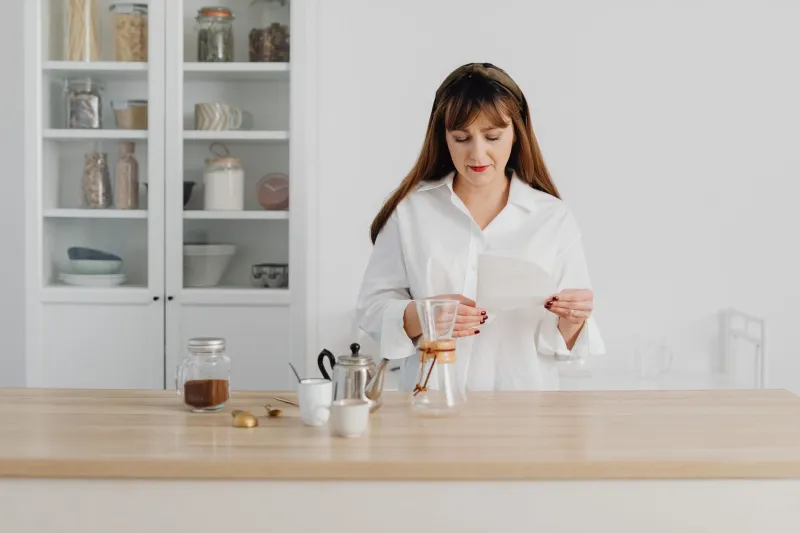
Mikkel, a Danish product designer who's been working remotely since 2019, puts it plainly: "I used to think I needed the right desk setup to focus. Good chair, proper monitor, nice light. Now I make the same coffee the same way every morning — same grind, same temperature, same five minutes of quiet — and I can work from almost anywhere. The coffee is just the trigger. What I'm really doing is telling myself the day has started properly."
The Danish Morning Blueprint
There's no single formula here, and that's rather the point — the ritual has to be yours, not borrowed wholesale from someone else's routine. But there are patterns worth noting among Danish long-term travellers.
Many begin with something slow and sensory before reaching for a phone. This might be five minutes of stretching, a cold splash of water, or — almost universally — a deliberate cup of coffee or tea made without multitasking. The emphasis is on the word deliberate. You're not gulping something down while checking Slack. You're actually tasting it, noticing the temperature, giving yourself a few minutes of purely analogue existence before the day's noise begins.
This isn't productivity hacking dressed up in Scandinavian clothing. It's closer to a small act of self-location — a way of answering the question your body asks every morning in an unfamiliar room: where am I, and am I alright? The ritual answers both, consistently, regardless of the postcode.
For British nomads raised on the chaos of commuter culture, this can feel almost suspiciously simple. Surely you need more than a quiet coffee to feel grounded? But simplicity is precisely the mechanism. Complex routines fall apart when you're crossing time zones or sleeping somewhere new every few weeks. Simple ones survive.
The Evening Wind-Down: Harder Than It Sounds
If mornings are about orientation, evenings are about decompression — and this is where a lot of remote workers, British ones especially, tend to struggle.
The always-on culture that UK workplaces have exported into remote life means that for many people, the working day doesn't really end. It just gets quieter. You're still half-checking emails at 10pm, still thinking about tomorrow's calls, still technically available. The physical separation between office and home that once forced a kind of psychological boundary has dissolved entirely.
Danish nomads tend to treat the evening ritual as a deliberate act of closure. Something that marks the end of work mode — not just the closing of a laptop, but a sequence of actions that tells the mind: we're done now. This might be a short walk with no destination, a specific playlist, a journal entry written by hand, or simply cooking something from scratch rather than ordering in.
Again, the content matters less than the consistency. Astrid, a Copenhagen-based UX researcher who splits her time between Denmark, Barcelona, and occasionally Edinburgh, keeps a small notebook she writes three sentences in every night — what went well, what she ate, what she noticed that day. "It takes four minutes," she says. "But it means I go to sleep having actually processed the day rather than just surviving it."
That notebook, incidentally, fits in the back pocket of her jeans.
Why British Nomads Are Starting to Pay Attention
The shift is visible, if gradual. In remote work communities across Europe, more UK-based travellers are talking less about accommodation specs and more about sustainable daily structures. Part of this is burnout — the Instagram-perfect nomad life turned out to be quietly exhausting when it relied entirely on external environments to deliver meaning. Part of it is practicality: when you're genuinely living this way long-term rather than for a three-month experiment, you can't keep optimising your surroundings every time they fail to feel like home.
But there's also something culturally interesting happening. British culture has historically been quite good at stoicism — getting on with it, not making a fuss — but not always great at the gentler art of self-tending. The Danish approach to daily rituals isn't self-indulgent. It's quietly functional. It treats your emotional state as infrastructure worth maintaining, the same way you'd maintain a work schedule or a budget.
Comfort, in this framing, isn't a luxury you arrive at after finding the right place. It's a practice you bring with you.
Starting Small (Which Is the Only Way to Start)
If you're a British nomad — or someone quietly contemplating the leap — the entry point here is genuinely low-stakes. Pick one morning action and do it the same way, in the same sequence, for two weeks. Make it something sensory and brief. Notice whether it changes how the rest of the morning feels.
Then, if you want, add an evening equivalent. Something that closes the day rather than letting it bleed into sleep.
You don't need a new bag, a better apartment, or a more photogenic destination. You need, it turns out, about eight minutes and a bit of Danish common sense.