Ssssh: Five Danish Islands Where the Main Attraction Is the Silence
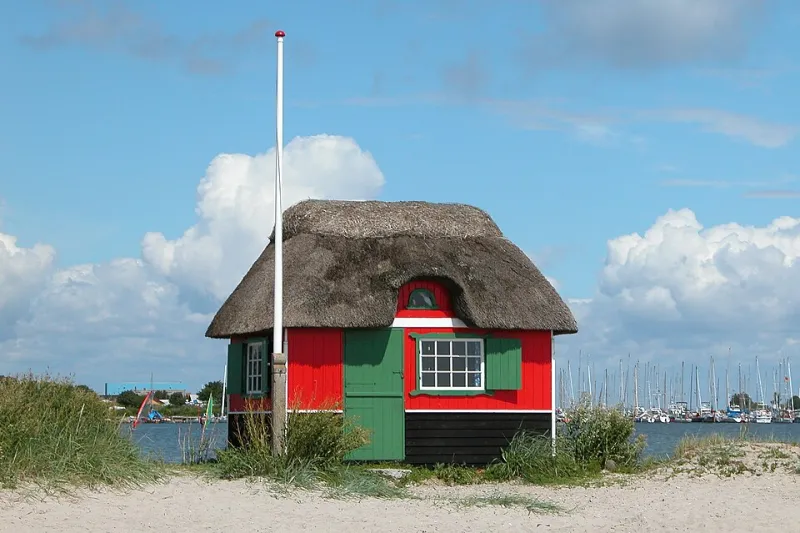
Photo: Erik Christensen, CC BY-SA 3.0, via Wikimedia Commons
There's a moment every British staycationer knows: you've driven four hours to somewhere beautiful, and now you're in a queue for it. A queue for the car park, a queue for the pasty, a queue of kayaks at the beauty spot. We've become experts at finding crowded places and then complaining about the crowds.
Denmark has islands — dozens of them — where that entire dynamic simply doesn't exist. Not because they're secret, exactly, but because they're quiet in a way that filters out everyone who needs noise. Here are five worth the crossing.
Ærø: The Island That Forgot to Rush
Ærø, in the Baltic south, is what happens when a place decides the 19th century had some good ideas and keeps them. Ærøskøbing's lanes of crooked, candy-coloured houses look like a film set, except people actually live in them. Getting there without a car is genuinely easy: train to Svendborg, then a short ferry. Once you arrive, you walk or hire a bicycle, and that's the transport plan for the week. 'Enough' here is a swim off the harbour, bread from the bakery, and an early night. If that sounds insufficient, Ærø is not for you — which is rather the point.
Læsø: Salt, Seaweed, and Not Much Else
Out in the Kattegat, Læsø is Denmark's oddest island: a flat, salty landscape where locals once made their living boiling seawater and where the houses are roofed with seaweed — genuinely, and beautifully. The ferry from Frederikshavn takes about 90 minutes. There are hot salt baths to soak in, dunes to wander, and a near-total absence of anything you'd call an attraction. Bring a book. The island rewards people who measure a day by how slowly it passed.
Møn: The Cliffs Worth the Climb
Møn's white chalk cliffs at Møns Klint are, admittedly, no secret to Danes — but compared to the scrum at Durdle Door, they're a meditation. Forest, dark skies (the island is one of Europe's best stargazing spots), and villages where the church is still the tallest building. Buses connect from Copenhagen via Vordingborg, so a car-free long weekend is entirely doable. What does 'enough' look like? One cliff walk, one天文 of stars, one very good smørrebrød.
Samsø: The Carbon-Negative Island
Samsø runs on wind — literally; the island produces more renewable energy than it uses, and has done for years. It's also a gentle, farming-and-strawberry sort of place with a slow ferry from Kalundborg and an annual festival that briefly wakes it up. The rest of the year, you can cycle the whole island in a long afternoon and spend the evening eating potatoes that were in the ground that morning.
Fanø: The Wadden Sea's Quiet Front Row
Just off Esbjerg — conveniently, if you've arrived on the overnight ferry from Harwich — Fanø faces the Wadden Sea's vast, bird-heavy mudflats. The town of Sønderho is a preserved captain's village; the beach is so enormous that locals fly kites the size of garden sheds. Seals included at no extra charge.
Why the Quietness Is the Product
None of these islands will thrill you, in the theme-park sense. There's no 'must-see' list, no queue economy, no need to book the good restaurant three months out. What they offer instead is the increasingly rare British luxury: a place where your presence doesn't require anyone else's sacrifice, and where the loudest sound, most evenings, is the sea doing its thing.
That's not a lack of things to do. That's the whole point.